

What does WisdomAI do?
WisdomAI transforms your company’s raw data into actionable insights through several key capabilities:Understands Your Questions
You can ask questions in everyday language, like “What was our revenue last quarter?” or “Which products are selling best?” WisdomAI uses advanced Natural-Language Query (NLQ) to understand what you’re asking.
Connects to Your Data
It seamlessly connects to various data sources your business uses, such as databases like PostgreSQL and SQL Server, or data warehouses like Snowflake and Google BigQuery.
Organizes Your Business Data
WisdomAI helps you organize your data into domains that represent different parts of your business, like Sales or Marketing. This makes your data more relevant and easier for everyone to use.
Turns Answers into Dashboards
Instead of just giving you numbers, WisdomAI can create interactive Dashboards with charts and text. They are automatically updated as your data changes, making it easy to share insights across your team.
Automates Workflows
You can set up Agents to automate everyday analytical tasks, from recurring analyses to threshold-based alerts, so your team gets answers without having to ask.
Learns and Improves
WisdomAI continually improves its capabilities based on user feedback. When you provide corrections or refine questions, the system learns to give even better answers in the future.
Who uses WisdomAI?
WisdomAI is designed for businesses of all sizes, from small startups to large corporations, across various industries. It’s intended to be useful for different roles within your organization:Admins
These are typically IT or BI directors who set up WisdomAI, connect it to your data sources, manage user access, and define the overall data structure on the platform.
Explorers
This group comprises business users, executives, and other stakeholders who utilize WisdomAI to ask questions in natural language, create and view Dashboards, share insights with their team, and subscribe to scheduled updates.
Developers
Software engineers and technical teams who build on top of WisdomAI — embedding dashboards into products, managing users via the API, or connecting WisdomAI to AI tools.
WisdomAI vs generic RAG systems
Unlike generic Retrieval-Augmented Generation (RAG) solutions that rely purely on embedding search over documents, WisdomAI builds a structured understanding of your data through semantic modeling, curated context, and validated logic.Data flow & architecture overview
WisdomAI transforms your business data into actionable insights using a multi-layered pipeline. The following components work together to deliver accurate, contextualized answers and auto-updating Dashboards.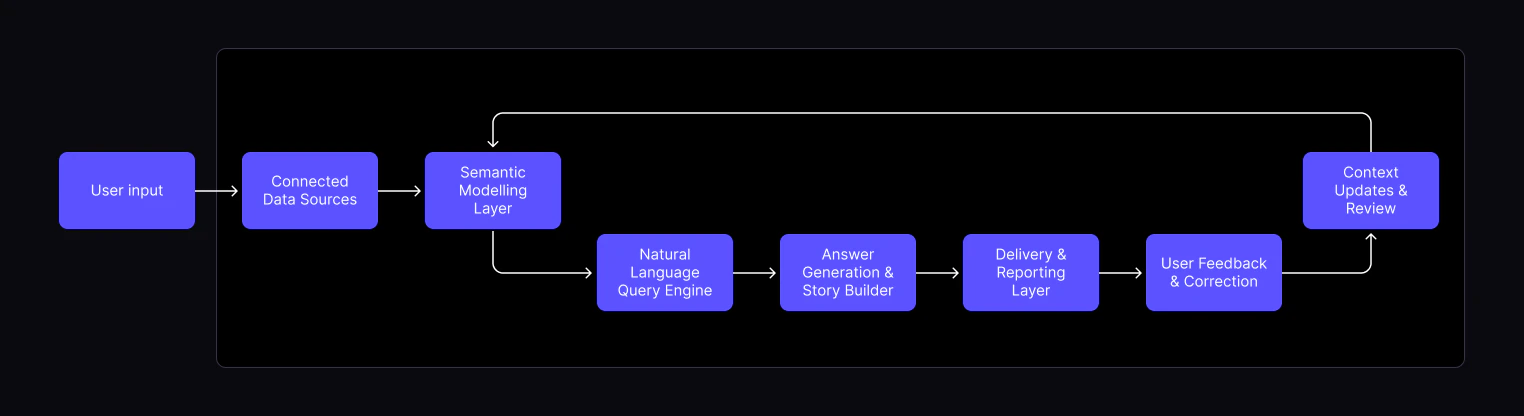
Connected Data Sources
WisdomAI integrates with your data platforms (such as Snowflake, BigQuery, or Redshift), serving as the entry point for all information flowing through the system.
Semantic Modeling
Admins and data owners enrich the data by documenting tables, columns, and domains. They also define relationships (e.g., one-to-many, many-to-many) to create a business-friendly context for natural language understanding.
Natural Language Query (NLQ) Engine
Users ask questions in plain language. The NLQ engine parses these questions and translates them into SQL queries using the underlying semantic model.
Dashboard Creation
Responses are generated and formatted into interactive Dashboards — data-driven narratives that combine visualizations, text, and insights. These can be scheduled and shared.
Delivery and Reporting Layer
Dashboards and answers can be delivered via email or embedded into external applications, helping teams stay informed with minimal effort.
User Feedback and Corrections
Users can give feedback on dashboard accuracy, suggest corrections, or add clarifying context to improve future results.
Next steps
Supported Data Sources
Explore the full list of databases and platforms you can connect to the system.
Connect and Test Tutorial
Walk through the initial setup to connect a data source and run your first query.
Advanced Data Modeling
Define relationships and context in your data to enable more powerful analysis.
Provide Feedback
Help improve model accuracy by rating answers and providing corrections.
Turn Answers into Dashboards
Compile key insights and visualizations into a shareable, narrative-driven report.